
Baseball fans love this time of year. The long, 162-game season finishes up in September and the playoffs start in October.
But even if you don’t follow baseball (or if you gave up on the Blue Jays this season), there is still something you can learn from baseball players. Especially if you are a preacher or teacher.
In my book, The Heart of the Preacher, I tell how a well-known Toronto Blue Jay star, Jose Bautista, become a noticeably better hitter. Then I make the case that there is an important lesson preachers and teachers can learn from Jose’s story. It’s a lesson about the value of coaching.
Some baseball players never seem to live up to their potential. In spite of having God-given talents to excel, they never do. They may be drafted by a major league team, show flashes of greatness, even have a respectable, journeyman career. But they fail to reach their full potential. They stagnate and remain underachievers.
That could have been José Bautista’s story if it weren’t for Dwayne Murphy. In a 2015 ESPN piece entitled “How Jose Bautista became Jose Bautista,” Dave Schoenfield chronicles Bautista’s early years as a pro.[1] After bouncing around the minors for several years, he made the roster of the Pittsburgh Pirates in 2006. For several seasons he played a backup role, hitting just over a dozen home runs each year. When he was picked up by the Toronto Blue Jays in 2008, no one saw him as a rising superstar. A good utility player, for sure. But a starter—highly unlikely!
All that changed when the Jays’ batting coach, Dwayne Murphy, started working with José. Murphy watched Bautista closely and noticed he generated great torque with his hip rotation but was slow in bringing his hands around. Murphy had Bautista relax and start his swing earlier by moving his top hand in a small semicircle about a second earlier than he had been doing. This small change would make a big difference.
Granted, it took weeks for José to get comfortable with this new swing. But when he did, the results were stunning. He hit twelve home runs in one month and developed into one of the best hitters in baseball for most of his career.
When it comes to realizing potential, preachers share something in common with major league ballplayers. We may be drafted by a local church, show flashes of homiletical excellence, and even become a respected, journeyman pastor. But we can fail to reach our full potential as preachers; we can be homiletical underachievers.
That’s why, like elite athletes, we can benefit from a coach. That’s why we need a Dwayne Murphy.
Who Is Your Dwayne?
In my role at Heritage College and Seminary, I listen to many preachers—both at the school and in churches. I’ve never heard a preacher yet (including yours truly) who wouldn’t benefit from coaching. Many preachers have strong, God-given gifts; however, all of us have specific habits and systemic patterns that keep us from hitting our potential. Like José Bautista before Dwayne Murphy, we swing hard but don’t connect as often as we’d like. In short, we would benefit from some coaching.
A preaching coach doesn’t have to be a better preacher than you are. When he was a player, Dwayne Murphy only hit half as many home runs as José Bautista. Yet good preaching coaches have two qualities that make them so useful. First, they know what a home-run sermon looks like. They understand the mechanics of sermon construction and sermon delivery. Second, they can spot exactly where a preacher is a bit off in his sermonic swing. They can identify, in specific terms, strong points and weak spots in a sermon. As a result, they can give customized counsel that goes far beyond the “Good sermon, Pastor” we sometimes hear at the door.
So let me ask you, preacher to preacher: Who gives you wise, knowledgeable feedback on your sermons? Who roots for your success as a preacher by helping you root out the bad habits in your preaching? Who is your Dwayne Murphy?
It’s great to read books and blogs on preaching. It’s wise to watch sermons from those who excel at biblical exposition. But nothing will bring more help than personalized, wise input from a coach.
Why We Don’t Have a Dwayne
Many preachers would agree a coach could help, but will never get any coaching. Why not? There are likely many reasons, but let me focus on two.
First, we don’t know whom to ask. Where do we find the preaching equivalent of a batting coach? Should we ask a pastoral peer who may not be any better at preaching than we are? A homiletics prof at a local seminary? How about an all-star preacher we’ve heard preach but don’t know personally? While finding the right coach can be a challenge, it’s not our major hindrance. I’m convinced there’s a deeper reason, one that gets to another test of our hearts.
Second, we don’t really want feedback. We feel uneasy about having someone scrutinize our sermons. Deep down, we live with insecurity about our preaching abilities. We know we aren’t hitting home runs most Sundays, but at least we usually get good wood on the ball. So why should we invite criticism? Who finds joy in finding out the flaws in their sermonic swing? On top of that, most people in the congregation seem generally content with our level of preaching. They may not be cheering, but they aren’t booing either—at least not loud enough for us to hear. So we play it safe and choose not to seek out an informed analysis of our preaching.
Here’s what I’ve discovered about these two objections. Once we deal with our self-protective reluctance to receive coaching, we discover it’s easier to find a coach than we expected. Once we’ve opened ourselves up to be coached, we’ve passed a test of the heart by confronting the temptation to stagnate and underachieve as preachers.
Finding a Dwayne
How do you go about engaging a preaching coach? Let me answer by telling you about an assignment I give to couples during their premarital counseling. I tell the engaged couple to identify a married couple whose marriage seems strong and satisfying. Then they are to approach this seasoned married couple with a request: “We want to develop a solid marriage, and we admire what we see in you. Could we take you out for coffee one time and talk about building a strong marriage?”
In my years of premarital counseling, I’ve never known an engaged couple to be turned down, even when they don’t personally know the older couple. In fact, the seasoned couple is generally delighted to be asked. They’ve worked hard on their marriage and are eager to see others flourish. While they initially might only agree to meet once, the relationship between the couples often turns out to be long-lasting. The young couple now has a marriage coach!
My advice to preachers looking for a preaching coach is similar: prayerfully identify a preacher in your circle of relationships (geographical, denominational) whose preaching ministry you admire. Approach him with a request: “I want to grow as a preacher, and I appreciate what I hear in your sermons. Could I take you out for coffee one time and talk to you about becoming a more effective preacher?”
Most preachers you ask will be encouraged by your affirmation and willing to have a conversation about effective preaching. Come to the conversation with a list of questions: How do you approach your preparation? How do you move from exegesis to exposition, from studying a text to structuring a sermon? How has God shaped your soul as a preacher? What do you know now that you wished you had known earlier?
Over the course of the conversation you will sense if this preacher could be a helpful coach. Is there good chemistry? Honesty? Candor? If so, ask him to watch or listen to one of your sermons and give you some feedback. Invite him to point out what he sees as strengths of the sermon and ways it could be strengthened. Make sure to thank him for investing time and energy into your life and ministry.
So far, I’ve written about coaching as if you can have only one preaching coach. While one coach is one more than most preachers have, it’s wise to think about assembling a coaching team. I’ve read that PGA golfer Phil Mickelson has a team of coaches who help him with various aspects of his game. Over the course of my ministry, I’ve received coaching from professors, peers, and my wife.[2] Each has provided a blend of encouragement and challenge, helping me to improve as a preacher.
When Paul wrote a letter to give Timothy some personalized coaching, he told him to work hard at preaching and teaching. He challenged Timothy not to stagnate or underachieve as a preacher. The outcome, Paul said, was that people in the congregation would see his progress (1 Timothy 4:15). They would be able to say, “He’s a better preacher this year than he was last year.” If you continue to grow as a preacher, getting some coaching along the way, the people in your congregation will be able to say the same thing about you.
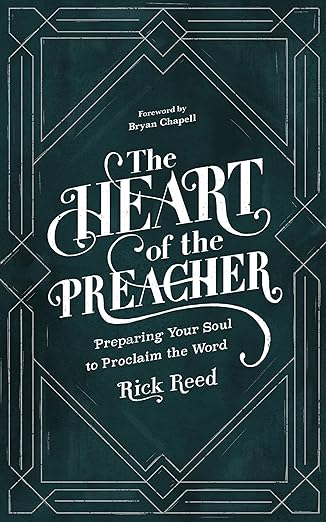
This article is taking from the book, The Heart of the Preacher, by Rick Reed. Used with publisher’s permission.
Buy a copy (paper or digital) of The Heart of the Preacher from Amazon or on a special sale at Christian Books.
Preachers: You can also learn about a video course that coaches preachers on how to get noticeably better. Click here.
[1] David Schoenfield, “How Jose Bautista became Jose Bautista,” Espn.com, October 19, 2015,
http://espn.go.com/blog/sweetspot/post/_/id/64975/how-jose-bautista-became-jose-bautista.
[2] See chapter 21, “Listen to Your Closest Ally.”
 Rick and Linda Reed