
There will be times in your life when you wonder what God is up to. Times when life gets puzzling or painful. When you feel you are losing the battle with losing your luggage. When you can’t seem to win over sin. Times when life seems far more about groaning than glory. When you struggle to make sense of what’s happened in your past or what’s happening in your present.
When you wonder what God is up to in your life make sure to turn to Romans 8. Because Paul answers your question is a clear, concise way. In Romans 8:28 Paul declares, “And we know that for those who love God all things work together for good, for those who are called according to his purpose” (8:28)
Romans 8:28 tells you what God is up to in your life. He’s up to something good!
Often, we treat Romans 8:28 as a stand-alone verse, extracted from the chapter in which it’s found. But when we look at this verse in the context of Paul’s flow of thought, we discover it carries special significance for all who long to lose their spiritual baggage and find their way to freedom in Christ. As we travel the trail towards glory, we can stay confident God is always up to something good in our lives.
I realize this answer is rather generic. To say “God is up to something good” still leaves us with unanswered questions. We wonder what good could possibly come from some of the things that happen to us. Thankfully, Paul gets down to specifics regarding what “something good” means in practical terms. If we look closely at Romans 8:28 and the next few verses, we discover three important truths which clarify the “good” God is up to in our lives as Christians. Let’s consider them one at a time.
God is up to something good in your life—even when life isn’t good
You’ll notice verse 28 says “all things” work together for good for those who love God. When Paul says “all things” he literally means “all things.” There’s no footnote or fine print giving exceptions or exclusions to this statement. “All things” encompasses everything that happens in your life.
“All things” includes all the suffering you go through. Paul isn’t saying all your suffering is good; he’s saying God is up to something good in all your suffering. As Elizabeth Elliot used to say: Suffering is never for nothing.[1]
“All things” also includes all the sins you commit, and all the sins others commit against you.
Don’t misunderstand. The Bible is not saying sin itself is good. It’s never good. However, the Bible teaches God is always up to something good in the midst of human sin. You might remember the words Joseph spoke to his brothers after they had sold him as a slave. “As for you, you meant evil against me, but God meant it for good, to bring it about that many people should be kept alive, as they are today” (Genesis 50:20). Joseph doesn’t rewrite history to excuse the evil his brothers committed against him. Instead, he understands God was at work in the midst of evil to bring about good purposes.
We may not always know the good God intends to bring out of our suffering or sin, but Paul says we can know God is always up to something good in the middle of it.
Stop for a moment and let this truth sink in. The Bible is affirming that no matter what happens in your life —the good, the bad, and the ugly—God is always working for your good.
The word translated “work together” is one you may recognize. The Greek word sunergeo gives us our English word “synergy.” Look up synergy in a dictionary and you’ll read “the interaction of elements that when combined produce a total effect that is greater than the sum of the individual elements.”[2] In other words, synergy refers to something where the final product is greater and better than the sum of its parts.
I’m thinking of the chocolate cherry cake my wife, Linda, makes. The individual ingredients are not all delicious. Who wants to eat a tablespoon of baking soda or baking powder? Who enjoys a mouthful of flour or a half cup of Canola oil? But when the various ingredients are combined by someone who knows what they are doing, the final product is mouth-watering. A chocolate cake is greater than the sum of its parts.
God knows what He’s doing as he works in your life. And He has both the power and the wisdom to work all the ingredients of your life into something good. Even when life isn’t good, God is up to something good. The outcome will be greater and better than the sum of the parts.
God is up to something good in your life—and it’s to make you like Christ
What is the good outcome God relentless works towards in your life? What “purpose” does he have for those who love him? (8:28)? Verse 29 tells you: he wants you to be “conformed to the image of his Son.” In other words, he’s working to make you like Christ. He purposes to conform your character and transform your body so that you are whole and holy. Your sinful baggage—completely gone.
We’ve now come to the place in our study of Romans 6, 7, and 8 where we get the big picture of the Christian’s journey towards glory. Have you ever taken a hike up a mountain and come to a scenic overlook, a vista where you can look down and see the trail below? Romans 8:28-30 provides a spiritual overlook or vista point for our lives as Christians. From these verses we can look back and get a panoramic view of where we’ve come on our journey towards holiness.
Looking back to where we started in Romans 6, you can now see your journey towards freedom started the moment you became united with Christ through faith in him. When you heard and believed the good news of the gospel, your life was eternally linked to Jesus’ life. God counted Jesus’ death to sin as your death to sin. You died to the slavery side of sin. What’s more, his resurrection became your resurrection to a new life. When you linked your life to Jesus by faith in him, your spiritual reality changed in an epic way. Now you must count yourself dead to sin and alive to God in Christ Jesus (6:1-11). You must see yourself as a slave to righteousness rather than a slave to sin. You can’t live like you used to live because you’re not who you used to be!
At this point, everything looked bright and promising. You had been set free to live out your new identity in Christ.
Then came Romans 7.
In Romans 7, you hit the headwinds of a harsh spiritual reality. While you died to the controlling power of sin, sin still lives in you. In Romans 7, Paul brings some bad news: you still carry leftovers from your old life—old ways of thinking and acting which Paul calls “the flesh.” As a result, you still struggle with stinkin’ thinkin’ and outlaw actions. In fact, Paul explains the flesh remains stronger than your good intentions and best efforts. Even when you want to do the right thing, you find yourself doing the opposite. How maddening and disheartening for a Christian who wants to please God!
Just when it seemed you were hopelessly stuck, unable to live in freedom and lose your luggage, you arrived at Romans 8. Here’s where you learned the way to win over sin and find freedom in Christ: you must walk by the Spirit.
As you lean on the Spirit’s empowerment, you find the power to live according to God’s “righteous requirement” (8:4). Walking by the Spirit starts in your head and moves to your body; the Holy Spirit helps you change your mindset and execute your sinful actions. The process of transformation isn’t automatic or easy. You still find yourself groaning as you grow. But in the midst of it all, God is up to something good. He working to conform you to the image of his Son, Jesus. He’s working to combine all the ingredients of your life into something glorious.
In fact, verse 30 goes on to boldface the glorious outcome God is working to accomplish in your life.
God is up to something good in your life—and the end of your story will be glorious.
I want you to notice how verse 30 promises a glorious ending to your story. “And those whom he predestined he also called, and those whom he called he also justified, and those whom he justified he also glorified” (8:30). All who are justified wind up glorified. In other words, those who are declared righteous (“justified”) will one day be completely righteous (“glorified”).
In verses 28-30, Paul gives you God’s perspective on your spiritual life as a Christians. From God’s vantage point, your story began before you did! Before your birth, God “foreknew” you. This means he set his sights and affections on you.[3] What’s more, he also “predestined” you to be conformed to the image of his Son. Predestined speaks of a “prior destination” God has planned for you.[4] Prior to your birth, God purposed to bring you to a place where your life looked like Christ—in both character and body.
Next, God “called” you to himself (8:30). He worked in your life to bring you the gospel. He moved your heart to respond in faith. When you did, He “justified” you (8:30). Because your life was linked to Jesus by faith, God declared you righteous in his sight. I like how someone summarized justification: God treats me “just-as-if-I’d” never sinned.
Finally, verse 30 says God “glorified” you. This speaks of the glorious inheritance you receive in heaven—a character with no sinful baggage and a resurrected body like Christ’s glorified body. This final stage of your journey is still in the future, but Paul talks about it as if it’s already happened. You see, from God’s perspective, it’s as good as done! Everyone justified by faith will one day be glorified. If you are a Christian, you will make it to the end of your faith journey. And the ending will be glorious. God will finish the good work he’s begun in you.
One of my favourite Christian musicians was Rich Mullins, an incredibly creative and insightful songwriter and singer. In addition to composing music, Rich was also an insightful writer. In one article, he wrote about an attic he remodeled into an apartment. The renovation process got messy and exhausting. At one point, Rich saw a parallel between the remodeling of the attic and the renovating of his soul. He writes,
Sometimes. . . . late at night when I look over the piles of dust and dry wall and knee-deep debris that remain during this reconstructive effort, I am strangely moved by the place and I proclaim the Gospel to it softly. I say, “I know how it hurts to be torn up. I am often choked on the litter left by my own remodeling. I know what it’s like to settle…into the despair of believing that you are wasted space. . . I know the pain of wanting to be changed and yet being distrustful of changes, of wanting to be worked on, but being suspicious of the intentions of the Worker. But here is some good news: He who began a good work in you will carry it on to completion until the day of Christ Jesus.” However messy it may be now, however confusing, and scary it appears, however endless the task may seem, we will someday be glorious, beautiful, alive![5]
In this spiritual remodeling project we call the Christian life, God is up to something good. And he promises to finish what he’s started. The end of your story will be glorious for you will be like Jesus. Knowing how your story ends should keep you from letting up or giving up. Understanding that all who are justified will one day be glorified, should give you confidence God is up to something good in your life. The end of your story will indeed be glorious. You will indeed lose your luggage.
[1] Elizabeth Elliott, Suffering is Never for Nothing (Nashville: B&H Books, 2019).
[2] dictionary.com https://www.dictionary.com/browse/synergy accessed December 15, 2021
[3] Thomas Schreiner contends that, in this context, the term foreknew “highlights God’s covenant love and affection for those whom he has chosen”. Thomas Schreiner, Romans, Baker Exegetical Commentary on the New Testament (Grand Rapids: Baker Academic, 2018), 445.
[4] Douglas Moo writes, “The ‘destination’ toward which believers have been set in motion is that we might ‘be conformed to the image of [God’s] Son.’” Douglas Moo, The Letter to the Romans, in The New International Commentary on the New Testament (Grand Rapids: Wm B. Eerdmans Publishing Company, 2018), 555.
[5] Rich Mullins, Attics and Temples, http://www.kidbrothers.net/words/release-magazine/release-magazine-fal93.html. Accessed February 4, 2022.
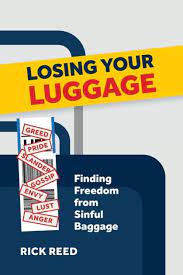
The material in this post is taken from a chapter of Rick’s book, Losing Your Luggage. If you’d like to purchase a paperback or eBook copy of the book, you can do so here.
 Rick and Linda Reed