
When you fall into sin again, in the very same area you’ve fallen down a hundred times before, how do you feel? If you are like me, you’d answer, “I feel guilty, lousy, stupid, discouraged, and defeated.”
Let me add one more word to the list: condemned.
I choose this word because it’s the one Paul uses after telling us something of his own struggle with sin. In the previous chapter, we listened to Paul’s lament about feeling defeated by sin. Even though he was a new person in Christ, even though he considered himself dead to sin and alive to God, he still found himself frustrated in his battle with sin. He wanted to do the right thing but kept doing the wrong thing. In his heart, he delighted to please God, but he found a civil war raging in his body. At the end of chapter 7, he cries out, “Wretched man that I am! Who will deliver me from this body of death? (7:24). Paul was feeling condemned. Sentenced and stuck.
It’s not a stretch to say most of us have felt—or currently feel—the same way.
But I’ve got some good news. Living with a heavy sense of frustration and condemnation doesn’t have to be the end of the story. It wasn’t for Paul. It doesn’t have to be for us either. I know that because Romans 8 follows Romans 7.
Romans 8 begins with good news for every Christian who has ever felt condemned by their repeated spiritual failures. Listen to what Paul writes in Romans 8:1: “There is therefore now no condemnation for those who are in Christ Jesus.” You read that right: “no condemnation.” Isn’t that welcome news to a weary, worn-out heart?
Once again, you may have questions as you read Romans 8:1. You may wonder how Paul could move so quickly from feeling condemned in chapter 7 to declaring no condemnation in chapter 8. That’s a good question. And we get a good answer in the first four verses of Romans 8. Read them carefully.
There is therefore now no condemnation for those who are in Christ Jesus. 2 For the law of the Spirit of life has set you free in Christ Jesus from the law of sin and death. 3 For God has done what the law, weakened by the flesh, could not do. By sending his own Son in the likeness of sinful flesh and for sin, he condemned sin in the flesh, 4 in order that the righteous requirement of the law might be fulfilled in us, who walk not according to the flesh but according to the Spirit.
As we take a closer look at these amazing verses, we discover what Paul means when he declares “no condemnation” and why he can be so confident this is the case for every Christian. There are two key lessons we need to learn from Romans 8:1-4. The first one comes in verses 1-3.
If you are in Christ, you are not condemned to pay for your sins.
The announcement of no condemnation comes as big news since all of us have lived under God’s condemnation. In the opening three chapters of Romans, Paul makes an air-tight case that no one stands innocent before God. Romans 3:23 indicts everyone who has ever lived: “for all have sinned and fall short of the glory of God.” Romans 6:23 sentences us to death for our sin: “For the wages of sin is death, but the free gift of God is eternal life in Christ Jesus our Lord.” Romans 7 piles on more condemnation by showing that even those who want to do the right thing continually come up short in doing it. No wonder we live under the weight of condemnation!
And yet, in spite of our repeated failure to obey God, Romans 8:1 declares “There is therefore now no condemnation for those who are in Christ Jesus.”
“Wait a second,” you say, “I still feel a heavy sense of condemnation for my sin. When I mess up, my heart condemns me, other people condemn me, and Satan condemns me as well. So, in my case, there is still great condemnation.”
When we sin, we can feel condemned by our own hearts, by those around us, and by Satan himself. And when others condemn us, they will often have solid evidence on their side. But they won’t have God on their side. He declares “no condemnation” and his verdict is the one that matters. As Romans 8:2 explains, God has set us free from “the law of sin and death.”
Again, you may ask, “But how can God set me free from condemnation when I sin? Afterall, God is just and righteous. Why doesn’t he condemn me?”
The answer comes in verse 3: “For God has done what the law, weakened by the flesh, could not do. By sending his own Son, in the likeness of sinful flesh and for sin, he condemned sin in the flesh.”
Did you see the answer? The reason God doesn’t condemn you for your sin is because he already condemned Jesus for your sin. God sent his Son Jesus “in the likeness of sinful flesh.” In other words, Jesus took on our likeness, our humanity. Though he never sinned, he looked just like the rest of us sinners.[1] He was fully God (God’s Son) but also fully human (flesh and blood). What’s more, verse 3 says God sent Jesus “for sin.” Some translations read, “to be a sin offering.”[2] Jesus came to sacrifice his life as an offering for our sins. For yours. For mine. For the sins of the entire world (1 John 2:2).
By dying on the cross “for sin”, God “condemned sin in the flesh” (8:3). God condemned Jesus in your place. So, if you are “in Christ Jesus” (8:1), if you have united your life to Jesus through repentance and faith, you are no longer condemned. Jesus took your condemnation.[3] Now, you are no longer condemned to pay for your sin.
You need to let this stunning truth sink in until you begin to feel the wonder of it and live in the reality of it. Most people—even Christians—have a hard time really accepting this truth. It seems too good to be true. We instinctively feel we need to do something to compensate for our condemnation. Our default response tells us we should help cover the costs of our repeated failures.
Back in 1986, a movie was released call The Mission. The storyline of the movie centers around Rodrigo Mendoza, a military officer turned slave trader. Mendoza is a vicious and violent man. In a fit of rage, he murders his own brother. Killing his brother almost kills him; he lives under a heavy weight of condemnation. So he makes his way to a Jesuit mission, seeking absolution for his many sins.
The priest at the mission has him gather up the accoutrements of his old life—his swords, shields, and body armour. After putting these weapons into a large net, the priests takes a rope and ties the net to Mendoza. He has Mendoza drag the heavy bundle to the base of a waterfall and then commands him to scale the cliff, from the base to the summit. We watch as Mendoza struggles to climb the steep cliff with the heavy net weighing him down. When he finally succeeds in making the arduous climb to the top, the priest cuts the rope and we see Mendoza’s heavy baggage fall to the river below.
It’s powerful cinematography. But it’s putrid theology. The message is that Mendoza, through his own struggle and striving, has atoned for his many sins. He’s climbed his way from condemnation to redemption.
But the Bible is clear: there is no mountain we can climb, no heroic effort we can make to cut us loose from the condemnation of our sinful baggage.
The good news, announced in Romans 8:1-3, is you don’t have to climb our way up to God. He sent Jesus down to us. More than that, Jesus bundled up your sins, my sins, and the sins of the whole world, and carried them to the cross.[4] Jesus gave his life for our sins. God condemned our sins in the person of His Son. We are cut free from the baggage of sin and death, not because we are incredible, but because we are “in Christ.” There is therefore now no condemnation for those who are in Christ Jesus (Romans 8:1). If you are in Christ, you are not condemned to pay for your sins. Jesus already did.
But the good news about no condemnation doesn’t stop here. There’s more in verse 4. In this verse you learn a second way you are freed from condemnation.
As you walk by the Spirit, you are not condemned to live in your sins.
Take a close look the wording of Romans 8:4: “in order that the righteous requirement of the law might be fulfilled in us, who walk not according to the flesh but according to the Spirit.” You’ll notice verse 4 begins with the words “in order that.” This phrase signals Paul is about to give us the “reason” why God condemned our sins in the body of his Son, Jesus. The reason was not only so you would be forgiven your sins. God wanted more. He also wanted you to be freed from them. Jesus died so you could finally live according to God’s “righteous requirement” and obey His law.
God’s purpose in sending Jesus wasn’t just to clean up the mess we had all made; it was also to make it possible for us to live new lives that please him and obey his commands.
You see, the word condemned has two different, but related, meanings. The word can mean to be “sentenced” for your sins. But it can also mean to be “stuck” in your sins, condemned to be forever enslaved to sins that displease God and destroy you and others. The first meaning (sentenced) comes out in verse 3; the second nuance (stuck) is highlighted in verse 4. Jesus died so you would not be condemned to live in your sins but rather to live in a way that fulfills God’s desire and demands. To put it in theological terms, God’s goal in your justification is your sanctification.
What’s the key to getting unstuck? Verse 4 tells you—it’s walking “according to the Spirit” (8:4). As you walk by the Spirit, you will not remain stuck in your sin.
At this point, I need to give you a bit of a spoiler alert for Romans 8. This chapter focuses attention on how God’s Spirit helps you lose your sinful baggage. The Holy Spirit was only mentioned one time in chapter 7, but the Spirit is referenced over twenty times in chapter 8. If 1 Corinthians 13 is the New Testament’s “love chapter”, Romans 8 could be called “the Holy Spirit chapter.” Romans 8 explains how God’s Spirit makes it possible for you to live out your new identity as Christians.
Before we go further in Romans 8, let me pause and trace Paul’s flow of thought from Romans 6 through 8. It’s important for you to follow the train of truth revealed in these chapters.
Romans 6 lays the foundation by declaring when you unite your life to Jesus through faith in him, you die to the slavery side of sin. You no longer are enslaved to sin; instead, you are now alive to God.
Romans 7 explains why you still struggle to live out your new identity in Christ. You continue to carry leftovers from your old life before Christ. Paul calls these spiritual leftovers “the flesh”—the old mindset and muscle memory which pulls you towards sin and away from God. As Paul laments, the flesh consistently overpowers your good intentions and best efforts to live for God. In spite being freed from slavery side of sin, you can still feel like sin always wins.
Right when you are ready to echo Paul’s cry of frustration in Romans 7:24 (“Wretched man that I am, who will deliver me from this body of death?”), a ray of hope breaks through: “Thanks be to God through Jesus Christ our Lord” (7:25). The sunrise of hope dawns as Romans 8 rises from the shadows of Romans 7. You are not condemned to be sentenced for your sin because Jesus has taken your condemnation on the cross (8:1-3). But there’s more. You are not condemned to remain stuck in your sin because the Holy Spirit has come to walk you towards freedom (8:4). Throughout the rest of Romans 8, Paul unpacks what it means to walk according to the Spirit and lose your sinful baggage.
You could sum it up by saying that finding freedom takes being in Christ and walking by the Spirit.
There is still much to discover in the remainder of Romans 8 about how to walk by the Spirit. We’ll do that in the pages that follow. But let me close this chapter by giving you an illustration that helps me understand what walking by the Spirit looks like in daily living. Let me tell you a story Bill Lawrence told me about Grandma Little (you’ll remember Bill Lawrence from chapter 2).
When Bill and his wife, Lynna, lived in California’s Silicon Valley, they would often drive to a retirement home to visit Lynna’s grandmother. They came to give her an outing by taking her to their home for the afternoon. When Bill and Lynna arrived they usually found Grandma Little sitting in her rocking chair, dressed and ready to go. Bill says he and Grandma Little replayed the same conversation each week. Bill would say, “Good afternoon, Grandma Little. How are you doing today?” “Pretty good” was her standard answer. “Are you ready to go?” Bill would ask. “Yes, but not too fast”, she’d reply.
Then Bill would lean down and offer Grandma Little his arm to help her stand. As they walked down the long hallway to the parking lot, Grandma Little would lean on Bill’s arm to steady herself. Grandma Little walked by the strength of Bill Lawrence. She used her legs but still needed his strength.
Bill told us he often imagines the Holy Spirit having a conversation with him at the start of the day. The Spirit whispers, “How are you doing today, Bill?” “Pretty good”, he replies. “Are you ready to go?” “Yes, but not too fast.”
And then, Bill told us, he consciously and continually leans on the Holy Spirit as he steps into the day. Bill Lawrence walking by the strength of the Holy Spirit, leaning on God’s Spirit for the power to walk in God’s ways and fulfill His righteous requirements.
That’s a helpful picture of what it means to walk by the Spirit. We are active, engaging our minds, mouths, and bodies. But we are also dependent, leaning on the strength the Spirit provides to enable us to move forward spiritually. As we walk by the Spirit, we do so with dependence and joy! For we know that, even though we stumble at times, there is no condemnation for those who are in Christ Jesus.
Are you ready to start walking by the Spirit and lose some luggage? In the next chapter, you’ll discover this journey starts in your head!
[1] Robert Mounce writes: “If Christ had not taken on our nature, he could not have been one of us. On the other hand, had he become completely like us (i.e., had he sinned), he could not have become our Savior.” (Romans, New American Commentary, online Logos version)
[2] See NIV and also NASB translations.
[3] As Charles Cranfield writes, “for those who are in Christ Jesus . . . there is no divine condemnation, since the condemnation they deserve has already been fully borne for them by him” Charles Cranfield, Romans 1-8 (Edinburgh: T&T Clark, 1975), 373.
[4] see 1 John 2:2: “He is the propitiation for our sins, and not for ours only but also for the sins of the whole world.”
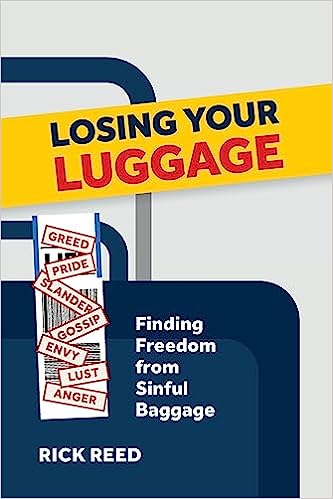
The material in this post is taken from a chapter of Rick’s book, Losing Your Luggage. If you’d like to purchase a paperback or eBook copy of the book, you can do so here.
 Rick and Linda Reed