
If you want to strengthen your heart as a preacher, it isn’t enough to respond to various tests as they come up. You need to proactively set your heart: “For Ezra had set his heart to study the Law of the Lord, and to do it and to teach his statutes and rules in Israel” (Ezra 7:10). Setting your heart involves establishing core convictions to guide you as a person and as a preacher. These convictions shape how you approach God’s Word to study, practice, and teach it. These convictions help stabilize you as a preacher when you face critical feedback or cultural pressure.
A primary, heart-level conviction that will strengthen your soul to proclaim God’s Word is the decision to become and remain an expository preacher. The word “expository” is more than a bit fuzzy for many people. Some think being an expository preacher means your sermons are a verbal verse-by-verse commentary on a passage of Scripture. Others assume it means preaching sequentially through Ephesians, Genesis, or another book in the Bible. Some associate exposition with being strong on historical explanation but weak on relevant application. So before making a commitment for or against exposition, a preacher must be clear on what is involved.
Haddon Robinson Meets Robert Frost
In his book Biblical Preaching, Haddon Robinson, a leading advocate for expository preaching, provides a single, penetrating question to help us determine whether we are committed to expository preaching: “Do you as a preacher endeavor to bend your thoughts to the Scriptures or do you use the Scriptures to support your thoughts?”[1] Expositors bend their thoughts to Scripture; non-expositors do the reverse.
To adapt a line from poet Robert Frost, two roads diverge in the homiletical woods.[2] At this homiletical fork in the road, all preachers must decide which path to follow. The expository path—the road less traveled—follows the text wherever it leads. On the expository path, the Scripture, not the preacher, sets the sermon’s direction. The alternative path heads in a direction chosen by the preacher. Scripture may be used on this path, but it’s not followed in the same way.
Not everyone champions the expository path as the right one for preachers and audiences. Take Harry Emerson Fosdick, a well-known preacher from the early twentieth century. While some in Fosdick’s day advocated expository preaching as the cure for shallow sermons, Fosdick saw it only as the cure for insomnia:
Many preachers … indulge habitually in what they call expository sermons. They take passages from Scripture and, proceeding on the assumption that the people attending church that morning are deeply concerned about what the passage means, they spend their half hour or more on historical exposition of the verse or chapter, ending with some appended practical application to the auditors. Could any procedure be more surely predestined to dullness and futility?[3]
So does a commitment to exposition guarantee irrelevant, boring sermons? While anyone can preach a boring sermon, a commitment to exposition doesn’t increase the odds. In fact, expository preaching done well not only proves faithful to Scripture but also fascinating to listeners.
What Harry Emerson Fosdick Missed
Fosdick misunderstood expository preaching, so he missed the major advantages it brings to both preachers and their congregations. Here are just three of the benefits of a commitment to exposition.
1. More authority in your sermons. Preacher, who do you think you are to tell others what to think or do? What gives you the right to impose your ideas on others? Why should anyone listen to you?
Expository preachers answer these questions with a confident humility. We say, “I have no authority in myself to tell anyone what to think or do; but God does. My authority is derived from and dependent upon his Word.”
Since the Bible is the Word of God, those who faithfully exposit Scripture speak with God’s authority. Only as we accurately expound the Word of God can we honestly claim God’s backing for our sermons.
In fact, if we don’t ground our preaching squarely on God’s Word, we build on some other foundation. It may be our own ideas, prevailing cultural thinking, or the latest scientific or sociological findings. But if it is something other than Scripture, we stand on shifting sand. Only as we preach God’s Word can we give people rock-solid truth. Only then do we prepare them to weather the storms of life and the deluge of judgment day (Matthew 7:24–27).
2. More nourishment for your people. Back in Jeremiah’s time, the preachers getting the most attention were serving up a steady diet of their own dreams and visions. God assessed these sermons as spiritual junk food. He wanted spokesmen who fed people his Word: “‘Let him who has my word speak my word faithfully. What has straw in common with wheat?’ declares the Lord” (Jeremiah 23:28).
What was true in Jeremiah’s day remains true today. To help people grow up spiritually healthy, we must feed them a nourishing diet of God’s Word rather than our own dreams and visions. It shouldn’t surprise us that the Greek words translated “sound doctrine” in Titus 2:1 (hygiainousē didaskalia) literally mean “healthy teaching.” When our sermons faithfully exposit the truth of a passage of Scripture, we are giving people nutritious messages that promote spiritual health.
3. More variety in your sermons. Instead of making sermons predictably similar, exposition actually pushes preachers toward greater variety in their sermons. Scottish preacher James Stewart explains why:
The preacher who expounds his own limited stock of ideas becomes deadly wearisome at last. The preacher who expounds the Bible has endless variety at his disposal. For no two texts say exactly the same thing. Every passage has a quite distinctive meaning. It is not the Holy Spirit’s way to repeat Himself.[4]
Those who set their hearts to be expository preachers actually lift a burden off their souls. The decision to faithfully “expose” the message of Scripture in our sermons relieves us of the pressure of devising novel or impressive things to say. It is the Word that speaks with authority and power, the Word that penetrates to the “division of soul and of spirit” (Hebrews 4:12), the Word that feeds hungry hearts, the Word that changes lives.
Staying on the Path
Choosing to head down the expository path is essential, but it is not enough. After selecting the right homiletical path, we must determine to stay on the path. It’s quite possible for a preacher to be mentally committed to expository preaching but functionally engaged in something else.
Duane Litfin, one of my preaching professors at seminary, explains what it means to stay on the expository path. “The substance of your preaching should be both derived from and—here is the kicker—transmitted through the study of a passage of the Bible. This is what it means to say a sermon is expository.”[5]
Litfin is on to something important when he calls for sermons “transmitted through the study of a passage.” Here is where many preachers wander off the expositional path. The messages they prepare stray far afield from the author’s flow of thought. As a result, they wind up in the homiletical weeds.
Expository sermons, at their best, follow the terrain of the text. The sermon is developed in a way that leads people to track with the biblical author’s flow of thought as expressed in the passage. The preacher’s explanations, declarations, applications, and gospel invitation all grow out of the soil of the text. At times the passage even provides some of the preacher’s illustrations. This is what Litfin means when he speaks of having the “substance” of our sermon being “transmitted through the study of a passage.”
In short, expository preachers don’t just read the text at the start of the sermon or use the text as a starting point for their own thoughts. The passage is not just the trailhead for the sermon; it is the trail! Expository preachers work hard to keep the minds and hearts of their hearers in close proximity to God’s Word.
How do we walk out a commitment to selecting and staying on the expository path as we prepare and preach our sermons? Here are three steps that will lead us in the right direction in sermon exegesis, development, and delivery.
In your sermon exegesis, give primary energy to understanding what the biblical writer said. Through careful exegesis and prayerful reflection, seek to track the author’s flow of thought and discover his pastoral purpose. Resist the pull to chart your own homiletical path but seek to faithfully retrace the biblical author’s conceptual footsteps.
As you develop your sermons, craft them so they lead people on a journey through the passage, following the biblical author’s flow of thought. Make it your goal to help your hearers clearly see how your explanation and applications come right from the passage.
Finally, keep people’s attention on the text of Scripture as you deliver your sermon. Don’t simply read the passage at the outset of the message and then, figuratively or literally, put your Bible down and make your own way forward. Instead, regularly and repeatedly point people to important features of the text. Heed the wise counsel John Piper offers beginning preachers (which applies equally to seasoned ones!):
Again and again my advice to beginning preachers is, “Quote the text! Quote the text! Say the actual words of the text again and again. Show the people where your ideas are coming from.” Most people do not easily see the connections a preacher sees between his words and the words of the text he is preaching from.[6]
Two roads diverge in the homiletical woods. Along one path walk preachers who bring their thoughts to the text, using Scripture to support their own ideas. Along the other path go preachers who bend their thoughts to the text, submitting their ideas to Scripture. Only preachers who consistently choose to bend their thoughts to the text walk on the expository path, thus reassuring their hearts by knowing that the power behind their sermons is from God and not their own opinions. For too long this has been the road less traveled. Thankfully, there are promising signs of change. God is raising up a generation of preachers committed to staying on the expository path. I encourage you to be one of them.
[1] Haddon Robinson, Biblical Preaching (Grand Rapids: Baker Books, 1980), 20.
[2] Robert Frost, “The Road Not Taken,” Poetry Foundation, https://www.poetryfoundation.org/poems/44272/the-road-not-taken.
[3] Harry Emerson Fosdick, “What Is the Matter with Preaching?” in Mike Graves, ed., What’s the Matter with Preaching Today? (Louisville: Westminster John Knox Press, 2004), 9.
[4] James Stewart, Heralds of God (New York: Charles Scribner’s Sons, 1946), 109.
[5] Duane Litfin, “New Testament Challenges to Big Idea Preaching” in Keith Willhite and Scott M. Gibson, eds., The Big Idea of Biblical Preaching (Grand Rapids: Baker Books, 1998), 55.
[6] John Piper, Preaching and the Supremacy of God (Grand Rapids: Baker Books, 1990), 88.
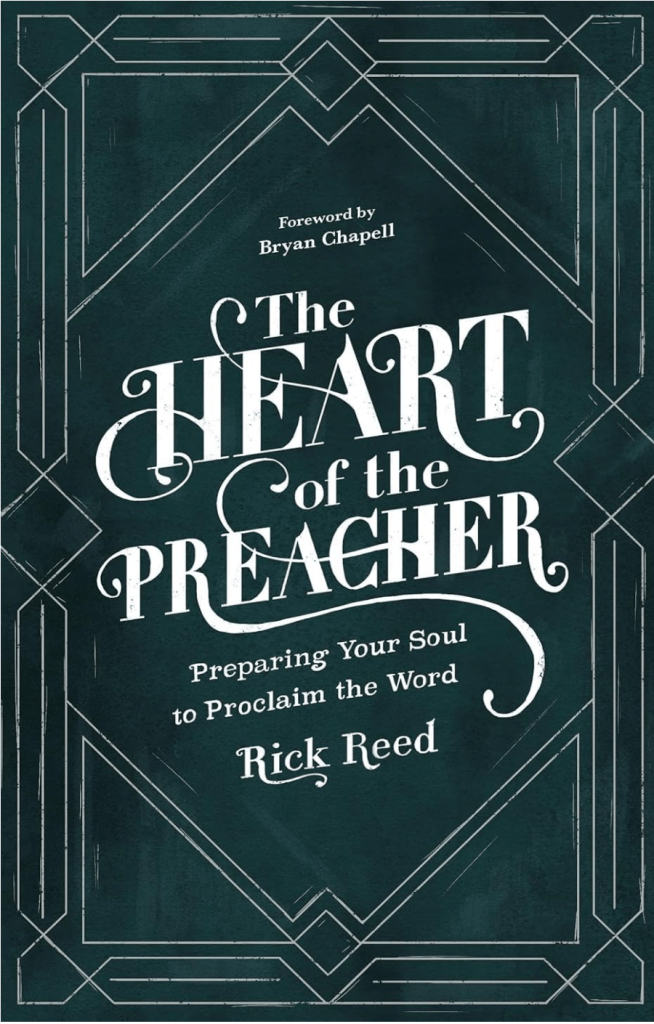
This article is taking from the book, The Heart of the Preacher, by Rick Reed. Used with publisher’s permission.
Buy a copy (paper or digital) of The Heart of the Preacher here.
 Rick and Linda Reed