
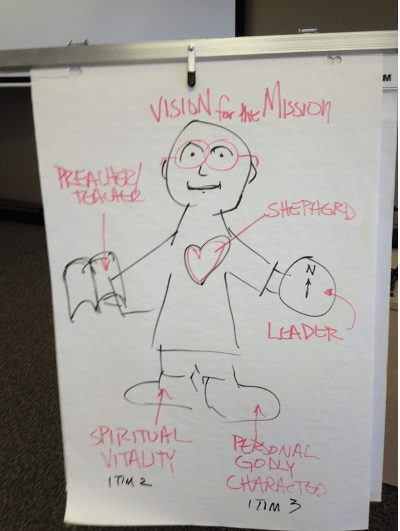
In the Pastoral Epistles, Paul gives Timothy and Titus (and all of us) a picture of the kind of pastoral leader needed in local churches. Drawing from Paul’s words to Timothy and Titus, I drew a simple sketch of what a faithful pastor should look like. Here’s the sketch and the biblical basis behind it.
Stand Strong: Spiritual Vitality and Godly Character
Two legs, like pillars, give solid footing to a pastor. One leg represents spiritual vitality—life-giving union and communion with Christ. The other leg stands for godly character—personal integrity and credibility in life and ministry. Without the firm footing provided by a vibrant spiritual life and a godly character, a minister is shaky and will eventually stumble and fall.
Paul called both Timothy and Titus to maintain their spiritual vitality and to display godly character.
“Let no one despise you for your youth, but set the believers and example in speech, in conduct, in love, in faith, in purity” (1 Tim. 4:12)
“Keep a close watch on yourself and on the teaching. Persist in t his, for by so doing you will save both yourself and your hearers” (1 Tim. 4:16)
“But as for you, O man of God, flee these things. Pursue righteousness, godliness, faith, love, steadfastness, gentleness. Fight the good fight of the faith.” (1 Tim. 6:11-12)
“So flee youthful passions and pursue righteousness, faith, love, and peace, along with those who call on the Lord from a pure heart” (2 Tim. 2:22)
“Show yourself in all respects to be a model of good works” (Titus 2:7)
Love the Sheep: SHEPHERD
A pastor, to be faithful and fruitful, must have the heart of a shepherd. Biblically speaking, the metaphor of a shepherd speaks of leaders who provide oversight and care for others. Faithful shepherds lead from a heart of love for those under their care. They remind people of the Lord Jesus, the Good Shepherd, who loved His sheep enough to lay down His life for them. Pastors who show the love of Christ help create a healthy, family-feel in their churches.
Paul’s letters to Timothy call pastors to demonstrate the shepherding love of Christ to those under their care.
“The aim of our charge is love that issues from a pure heart and a good conscience and sincere faith” (1 Tim. 1:5)
“. . . set the believers an example in speech, in conduct, in love. . . .” (1 Tim 4:12)
“Do not rebuke an older man but encourage him as you would a father, young men as brothers, older women as mothers, younger women as sisters, in all purity” (1 Tim. 5:1-2)
Feed the Sheep: PREACHER/TEACHER
In this picture of a faithful pastor, you find a Bible in one hand. Pastors must be devoted to God’s Word, doing their best to study it, practice it, and teach it to others. While pastors must do more than preach well, they can’t do less. A congregation that isn’t regularly and repeatedly fed nutritious spiritual meals from God’s Word becomes weak and anemic.
Paul’s instructions to Timothy and Titus echo Christ’s command to Peter to “feed my sheep” (John 21:17). The command to preach and teach the Word rings out throughout the Pastoral Epistles. Here’s just a sampling.
“Command and teach these things” (1 Tim. 4:11)
“Until I come, devote yourself to the public reading of Scripture, to exhortation, to teaching” (1 Tim. 4:13)
“You then, my child, be strengthened by the grace that is in Christ Jesus, and what you have heard from me in the presence of many witnesses entrust to faithful men who will be able to teach others also” (2 Tim 2:2)
“Do your best to present yourself to God as one approved, a worker who has no need to be ashamed, rightly handling the word of truth” (2 Tim. 2:15)
“I charge you in the presence of God and of Christ Jesus, who is to judge the living and the dead, and by his appearing and his kingdom: preach the word; be ready in season and out of season; reprove, rebuke and exhort, with complete patience and teaching” (2 Tim. 4:1-3
“But as for you, teach what accords with sound doctrine” (Titus 2:1)
“…in your teaching show integrity, dignity, and sound speech that cannot be condemned, so that an opponent may be put to shame, having nothing evil to say about us” (Titus 2:7-8)
Lead the Sheep: LEADER
In this picture of a faithful pastor, there is a Bible in one hand and a compass in the other. The compass represents another core competency required of spiritual leaders—they must know how to lead people in God’s ways. While providing leadership may not come easy to some pastors, God expects and empowers all pastors to grow into wise, effective leaders.
Timothy may have been a reluctant leader who battled with some “timidity” (1 Tim 1:7), but Paul still called him to give pastoral leadership to the congregation. He did the same for Titus, as these verses show.
“As I urged you when I was going to Macedonia, remain at Ephesus so that you may charge certain persons not to teach any different doctrine” (1 Tim. 1:3)
“I hope to come to you soon, but I am writing these things to you so that, if I delay, you may know how one ought to behave in the household of God, which is the church of the living God, a pillar and buttress of the truth” (1 Tim. 3:14-15).
“For this reason, I remind you to fan in to flame the gift of God, which is in you through the laying on of my hands, for God gave us a spirit not of fear but of power and love and self-control.” (2 Tim. 1:6-7)
“This is why I left you in Crete, so that you might put what remained in order, and appoint elders in every town as I directed you.” (Titus 1:5)
“Declare these things; exhort and rebuke with all authority. Let no one disregard you” (Titus 2:15)
See the Mission: EVANGELIST
You will notice the glasses worn by the pastor in my sketch. The glasses are a reminder of a pastor’s essential need to have a clear vision of the Church’s mission. While we are not all evangelists by gifting, we are called to “do the work of an evangelist” (2 Tim. 4:5). Pastors need to wear bifocals: seeing lost people near and far, locally and globally. In fact, unless a pastor leads the way in seeking lost people, the congregation will rarely develop a heart for sharing and spreading the gospel.
Paul’s instructions to Timothy and Titus reveal his desire that pastors share his heart for the gospel of Christ.
“Therefore, do not be ashamed of the testimony about our Lord, nor of me his prisoner, but share in suffering for the gospel by the power of God” (2 Tim. 1:8)
“As for you, always be sober-minded, endure suffering, do the work of an evangelist, fulfill your ministry” (2 Tim. 4:5)
Putting the Picture into Pastoral Practice
Let me highlight three ways I’ve used this simple sketch over the years.
Personal Growth. While none of us who serve as pastors can claim to fit the picture perfectly, we all need to aspire to grow in each of the key areas highlighted by Paul in the Pastoral Epistles. Over the years, I’ve used this picture to set personal and practical goals to grow as a shepherd, leader, preacher, and evangelist. For example, to grow as a leader, I’ve set goals to study biblical principles on leadership and intentionally seek out conversations with more experienced pastoral leaders.
Ministry Focus. This picture has also helped me focus my energy and budget my time as a pastor. At the start of a new week, I’ve often written down several key ways I could live out each of the roles (shepherd, leader, preacher, evangelist) during the coming week. As I did this, I found I was more proactive (and less reactive) in how I served the congregation as their pastor. I was better able to use my time and energy in a biblically-focused way.
Mentoring Younger Pastors. I’ve used this simple picture to help younger pastors get a clear vision of what they should be doing as pastors. I’ve found the sketch to be easily remembered by those I mentor.
 Rick and Linda Reed