
The place goes by the name of Mensa Christi, which means “Table of Christ.” Situated on the northern shore of the Sea of Galilee, this quiet, rocky beach commemorates the spot Jesus served breakfast to seven of his disciples on a morning after his resurrection.
Of all the places we visited on our trip to Israel, Mensa Christi stands out as one of my favorites. Our group of ministry leaders and spouses gathered in a small, outdoor amphitheater near the shoreline. One pastor read the text of John 21 as we envisioned the disciples sitting round an open fire, eating a breakfast of fish and bread. It wasn’t hard to imagine the conversation between Jesus and Peter: “Simon, son of John, do you love me?” “Lord, you know everything; you know that I love you.” “Feed my sheep.”
Tears fell freely as I reflected on God’s grace to a disciple who had recently stumbled badly. John 21 rarely fails to move me. Maybe it’s because I identify with Peter. I, too, have made big promises to God and failed to carry them out. I, too, have wondered whether I was really cut out for ministry. There have been times I considered taking up a different line of work—though, in my case, fishing never made the short list of possible options.
But it’s not just that I identify with Peter in his stumbling. I also share his deep love for Jesus. Peter’s words find an echo in my heart: “Lord, you know all things; you know that I love you. Even when my actions haven’t shown it, even when I’ve failed you and others, you know my heart and know I love you. Often poorly, but truly.”
I’m also amazed by the way Jesus recommissions Peter into service, even on the far side of his defection and desertion. “Feed my lambs.” “Tend my sheep.” “Feed my sheep.” Jesus had already called Peter to be a fisher of men (Matthew 4:19). Now he calls him to be a shepherd of sheep.
Feeding Because of Love
Many years ago, I heard a seasoned pastor speak about what motivated him to keep going in ministry. He referenced John 21 and Jesus’ call to Peter. He explained that earlier in his life, he had heard Christ’s commission to feed his sheep. That sense of calling kept him preaching and pastoring—feeding and leading God’s people. Pastoral ministry was an expression of his love for Christ and faithfulness to his call.
I, too, have been commissioned to feed Christ’s sheep. I’m painfully aware of my own failings; nevertheless, I know I have been called to feed and lead Christ’s people as an expression of my love for him.
When it comes to motivations for preaching, we sometimes miss this most basic of all motivators: love for Jesus. Did you notice Jesus didn’t ask, “Peter, do you love my sheep?” Instead, he only asked, “Do you love me?” If our primary motivation for preaching is a love for people, we will struggle when people are hard to love. After all, sheep can wander; sheep can bite. But when ministry motivation arises from a genuine love for Christ, we have good reason to stay faithful. Especially since the One who calls us knows our less-than-rock-solid track record. Having been forgiven much by Christ, we love him much and show our love through feeding his sheep as we preach his Word. Like Peter, we willingly embrace the call to “shepherd the flock of God” (1 Peter 5:2). While there are many worthy motivations for ministry, the greatest of these is love. Love for Christ strengthens our souls to faithfully feed Christ’s sheep.
Following Because of Love
John 21 doesn’t end with Peter’s recommissioning to service. The shoreline conversation between Jesus and Peter continues with some news Peter must have found unsettling.
“Truly, truly, I say to you, when you were young, you used to dress yourself and walk wherever you wanted, but when you are old, you will stretch out your hands and another will dress you and carry you where you do not want to go” (21:18). Jesus’ words, while cryptic, have an ominous feel. Immediately after welcoming Peter back into ministry, Jesus warns him about his eventual suffering and death.
Understandably, Peter has questions. Wouldn’t you? Peter wonders when all this will happen. What will it look like? Will he be able to handle it, or would he crumble again as he had in the high priest’s courtyard? As questions must have multiplied in his mind, Peter turns and sees John standing nearby. He asks Jesus whether John is headed for the same kind of painful ending: “Lord what about this man?” (21:21). Jesus won’t go there. “If it is my will that he remain until I come, what is that to you? You follow me!” (21:22). Evidently, John’s story is none of Peter’s business. All he needs to know is that he is to follow Jesus, wherever it leads and whatever it costs.
In C. S. Lewis’s book The Horse and His Boy, young Shasta has an encounter with Aslan, not at daybreak on a quiet shoreline, but in the dark of night in a dense forest. Shasta pours out his life story, recounting the painful hardships he has experienced. To his surprise, he learns Aslan had been powerfully present in each of them. Still confused, Shasta asks about Aslan’s dealings with Aravis, a young girl he had met on his journeys. “Child,” Aslan replies, “I am telling you your story, not hers. I tell no one any story but his own.”[1]
Like Peter or Shasta, we sometimes have questions about those around us. We look over our shoulders in ministry and see someone who seems to have it better or at least easier than we do. “Lord, what about this man?” we ask. “Will he experience the kind of hardships I am facing?” But Jesus won’t go there. He doesn’t tell us another’s story. He simply calls us to follow him.
There’s a phrase in the text of John 21 that is strangely reassuring to me. After Jesus gives Peter a glimpse of his future, John adds, “This he said to show by what kind of death he was to glorify God” (21:19). I see a promise embedded in these words. Peter’s death was not to be viewed as a tragic end to a life of service but as his final act of earthly service, as the God-glorifying finale to his life’s song. Jesus viewed his own death through the lens of bringing glory to God. On the night he was arrested he prayed, “Father, the hour has come; glorify your Son that the Son may glorify you” (John 17:1). Peter’s death would follow the pattern of his Lord and bring glory to God.
Tradition tells us Peter was crucified like Christ. Jesus’ words in John 21:18 are eerily precise: Peter literally did “stretch out his hands.” There is some historical evidence that Peter had one final request of those who crucified him: he asked to be crucified upside down, not feeling worthy to die in the same position as his Lord. Peter’s love for Jesus strengthened him to follow faithfully to the very end. Love for Christ strengthens our souls to faithfully follow him for a lifetime.
My Jesus I Love Thee
At our daughter’s graduation ceremony at Gordon College in the spring of 2008, Judson Carlberg gave the commencement address. Judson had recently retired after serving as the president of the school for the past twenty years. Shortly after announcing his retirement, he was diagnosed with an advanced, aggressive form of cancer. As he addressed these newly minted graduates, all primed to take on life, he spoke to them from John 21. He talked of the grace of God that had come to him in the midst of his suffering, deepening his faith and his love for Christ. He challenged the graduates to follow Jesus for the rest of their lives—no matter where he leads or how their story ends.
At times, I get anxious about how my story will end. Having had cancer once, I sometimes fear it will return. New pains bring new worries. I wonder if there will be a return visit to the oncologist, if cancer will take me to a place I don’t want to go again. I don’t know the answer to those questions, any more than Peter did on the morning of his lakeshore conversation. All I know is that I have been called into Christ’s service by his grace. I’ve been commissioned to feed his people—young and old.
If you are called to preach God’s Word, the same holds true for you. So give yourself to the joyful task of studying his Word and preparing sermons, seeking to make them as nourishing and appetizing as possible. Refuse to be paralyzed by the fear of what could happen in the future, focusing instead on what needs to happen in the present. Out of love for the One who has forgiven you and given you this calling, stay faithful until your earthly story ends.
We finished our visit to Mensa Christi inside a small chapel near the water’s edge. Our group of pastoral couples crowded inside the stone walls, sparrows darting around above our heads. With a renewed sense of our own calling into ministry, we joined voices to sing a particularly appropriate hymn:
My Jesus I Love Thee, I know Thou art mine.
For Thee all the follies of sin I resign.
My gracious Redeemer, my Saviour art Thou.
If ever I loved Thee, my Jesus ‘tis now.[2]
I left Mensa Christi with a renewed sense of calling to ministry. For me, this calling centers on preaching God’s Word to feed Christ’s people. I also left Mensa Christi with something else, something even more valuable—a renewed sense of love for the One who called me into ministry. Ultimately, keeping our love strong for Christ is the main way we keep our hearts strong as preachers.
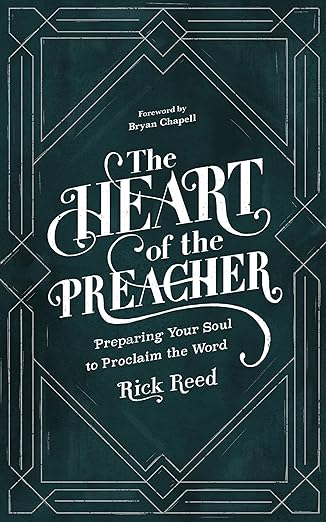
This article is taking from the book, The Heart of the Preacher, by Rick Reed. Used with publisher’s permission.
Buy a copy (paper or digital) of The Heart of the Preacher here.
[1] C. S. Lewis, The Horse and His Boy (New York: Macmillan, 1954), 141.
[2] William R. Featherston, “My Jesus I Love Thee,” 1864, http://library.timelesstruths.org/music/My_Jesus_I_Love_Thee/.
 Rick and Linda Reed